
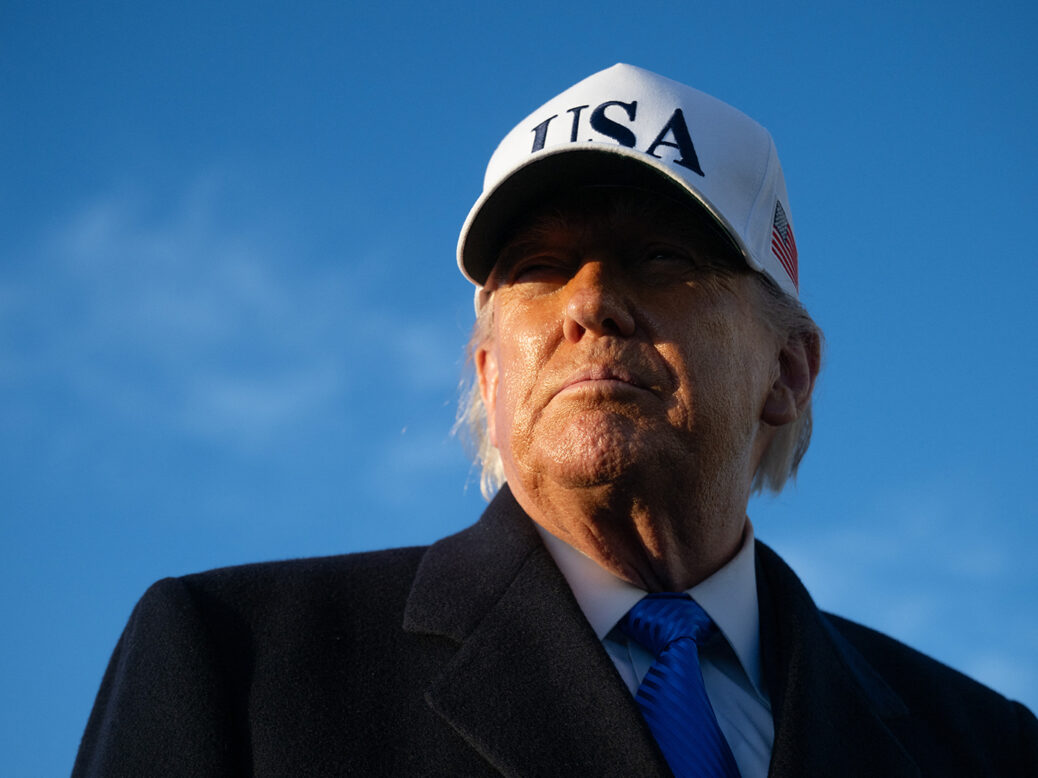
A new series of Have I Got News for You starts on 3 April. The first host is the very funny Roy Wood Jr, who fronts the American version of the show on NBC. He is not a huge fan of President Trump and the first time he appeared on the British show he began by saying he was over here seeking asylum. This is an admirably bold stance given that the company CNN, which produces the US show, has a Trump-leaning new parent company, and the US president is extremely thin-skinned about any sort of criticism, let alone jokes. UK viewers, on the other hand, have been keen on Wood despite a few of them still thinking, in a very parochial misinterpretation of the booking process, that he might be the son of Roy Wood from Wizzard, who sings: “I wish it could be Christmas every day.” He isn’t.
***
Have I Got News has been going a long time now, I know, but I was very encouraged by a woman on the Tube yesterday. She looked at me and said: “It’s not you, is it?” I was tempted to say, “No, it isn’t me,” but thought that this was not a very convincing (or, indeed, logical) reply, so I just admitted it. She then told me that when she originally came to this country from Chile ten years ago, she watched Have I Got News, didn’t understand a word of it and couldn’t see the point of it at all. I said, “Yes, fair enough.” She continued that she later suddenly “got it” and is now an avid viewer. She laughed and concluded: “That was the point when I realised I had become British.” True Story – as Donald Trump would say. Except that this really did happen. Feedback isn’t always so positive, however. I was walking down the pavement on Piccadilly the other day and a man in an elegant suit walked up, pointed at me and said simply: “Not funny.” He then continued happily on his way.
***

I attended a fundraising event for the National Literacy Trust (NLT) the other week for its National Year of Reading. The NLT is an excellent charity and does really solid, well-directed work to promote reading among those children who do not have the encouragement or the opportunities to develop reading habits. I was asked to say a few words, and was going to be sincere and point to the research about the disadvantages suffered by lack of reading. Halfway through the sentence: “If you are illiterate, there is a good chance that you will end up…” I hesitated, and then couldn’t help myself finishing: “… as president of the United States of America.”
I know there are more important points about Trump than his use of language, but for example his statement that, “I think the war is very complete. Pretty much,” seemed to show that he is happy to break not just international law but all the laws of grammar and indeed sense.
Lent is traditionally a time for self-reflection, and I always recall the most negative response I have received to my career efforts. It was on Good Friday many years ago, when I was sitting in a sparsely attended service in a cathedral and suddenly realised that the sermon was directed entirely at me. The priest was not doing the more general rumination on the need for repentance and the forgiveness of sin, but very specifically talking about the heinous sins of Slander and False Witness, and looking straight at me. He was letting me have it with a strength of emotion unusual for a Church of England sermon. It was real passion during the Passion, I thought at the time. Which is a bit glib, and I expect he would have added that to my many sins.
***
I still love Easter as a festival and shall be going to Crete for Greek Easter, which, due to the mysteries of the Anglican and Orthodox Church calendars, is a week later than ours. I shall be attending the festivities on Saturday night in a local town, where there is a lake beneath the cliffs, on which floats a pontoon carrying a gibbet and an effigy of Judas Iscariot. At the moment of midnight, a fireball is sent along a rope from the top of the cliff that sets the entire pontoon alight and the whole things burns furiously and spectacularly. It is unashamedly medieval. There is then a huge firework display – some of it official, but with lots of unofficial contributions from local teenagers– which fills the bowl of the lake with a huge echoing row.
Back down on the lakeside the Orthodox priest chants from the liturgy, and, if this was not enough of a cacophony, the town band in uniform joins in. It’s not quite the Bach St Matthew Passion, but it is something rather wonderful. Everyone lights candles and wishes each other “Christos Agnesti”, to which the reply is “Alithos Agnesti”. Christ is Risen. Christ is Risen indeed. Then, to celebrate the Lamb of God there is a great deal of absolutely delicious lamb to be eaten. Happy Easter.
Ian Hislop is editor of “Private Eye”
[Further reading: Matt Goodwin’s intellectual suicide]
Content from our partners



Related



This article appears in the 25 Mar 2026 issue of the New Statesman, Easter Special
Join the debate
Subscribe here to commentThe Satirist and the Showman: A Study in Extremes
I admire Hislop as much as I dislike Trump. Yet, viewing them through half-closed eyes—as an artist might to blur the noise and find the form—an unsettling parallel emerges. They exist at such polar opposites that they eventually meet, much like the way totalitarianism produces the same grey misery whether birthed from a Communist or Fascist regime.
Hislop occupies the high moral ground of a judicial bench, launching precision-guided munitions. These are the “smart bombs” of verbal punishment, targeting injustices in his private court of judgement. His strikes are grammatically pristine, devastatingly accurate, and underpinned by the kind of inconvenient truths that leave politicians squirming.
Yet, gaze through that same squint and the connection to his orange-hued nemesis becomes clear. Both are maestros of the insult. Whether it is Trump’s clumsy but effective broadsides against the Japanese Prime Minister, the Macrons, or his palpable disdain for Keir Starmer and the Royal Navy, the result is the same: both targets and audiences are left agape.
Trump, too, revels in pointing out the “elephants in the room”—his own brand of inconvenient truths regarding NATO’s effectiveness, the state of the Royal Navy, or the hypocrisy of European policy. Both men represent the pinnacle of the verbal spectacle, wielding language to dismantle the establishment. While Hislop uses the Oxford comma to execute a character assassination, Trump prefers a chaotic flurry of “covfefe” and “huge” fabrications.
One is a surgeon of satire; the other, a blunderbuss of bunkum. Hislop’s comedy is the triumph of the footnoted fact, whereas Trump’s is the theatre of the audacious lie. Their methods are irreconcilable, yet both prove that in the modern age, the most potent weapon is not the sword, but a well-timed, televised insult.